
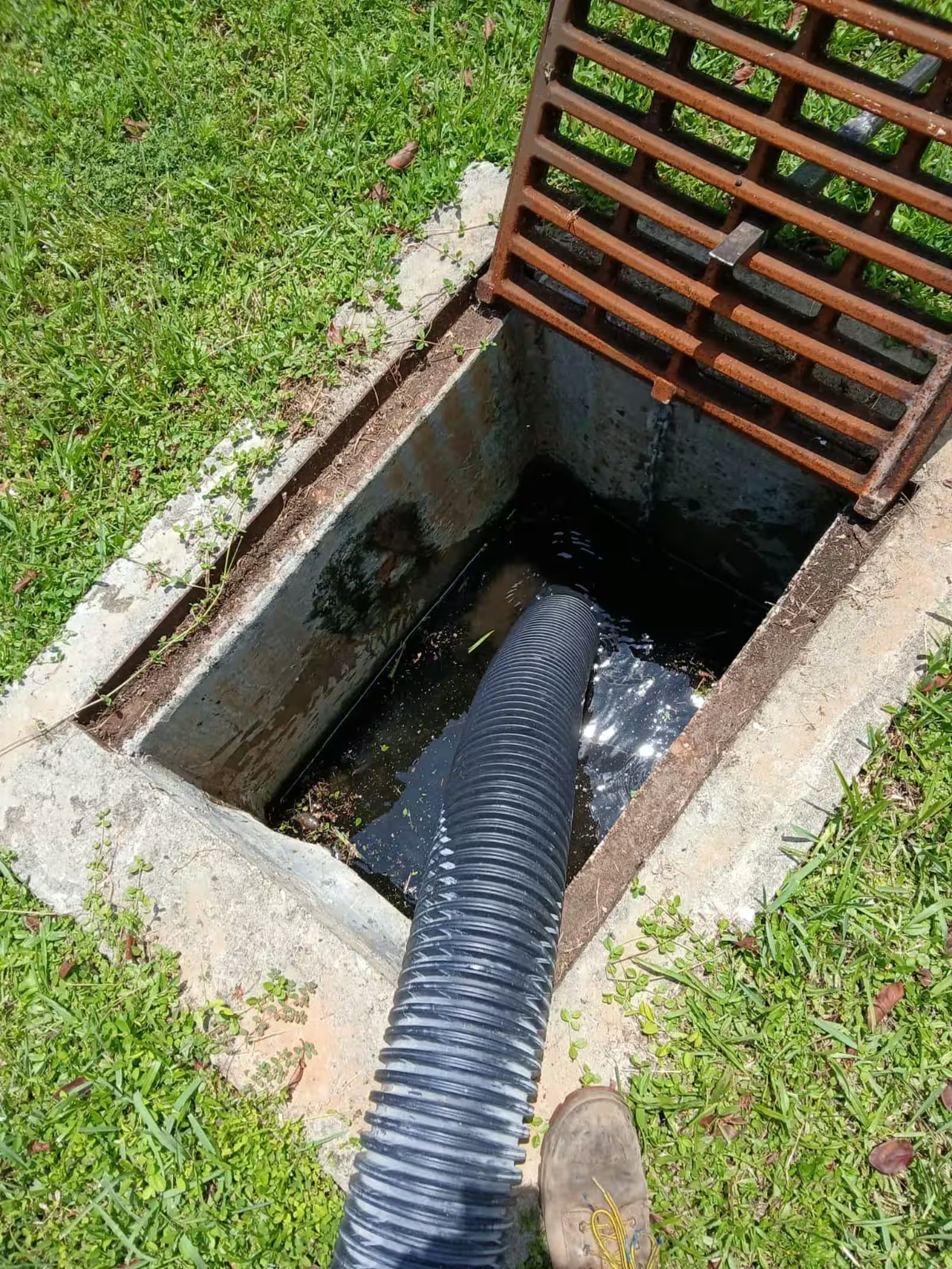
Storm drain cleaning in Miami, FL
Storm drain cleaning in Miami means working under Miami-Dade RER (DERM) stormwater rules, with sea-level groundwater and tidal outfalls in play. South Florida Storm Drain Solutions vacuums catch basins, hydro-jets pipe runs, and delivers DERM-ready documentation for HOAs, condo associations, and commercial properties from Brickell to Kendall.
- Written quote in 48 hoursFixed fee. Never increases.
- Zero-Denial GuaranteeRejected? We refile at no cost.
- Insured & bondedFlorida PE on staff.
Miami-Dade DERM enforces stormwater compliance year-round. Missed maintenance becomes a notice of violation.
Most boards don't know. We pull the county record and tell you the license number, status and expiration date.
Storm drain cleaning Miami: local stormwater context
The City of Miami operates an MS4 under FDEP NPDES Phase II inside the larger Miami-Dade RER (DERM) program. DERM enforces county stormwater, groundwater, and surface-water rules under Chapter 24 of the Miami-Dade Code, which are often stricter than the state or federal minimums. And most receiving waters (the Miami River, Biscayne Bay) are sensitive, so missing inspections and unmaintained inlets become a fast path to a notice of violation.
Coastal Miami also has a tidal-outfall problem: structures fill with sand, seaweed, and saltwater intrusion, and inspections have to be timed around tide. Inland sites along the Miami River and the older industrial corridors deal with much heavier sediment and FOG loads.
Most post-1990s commercial sites permitted detention or exfiltration systems through an SFWMD ERP. Recurring O&M inspections now fall under Florida's updated qualified-inspector rule under Chapter 62-330. The obligation itself, who holds it and how often it comes due, is laid out in our Florida stormwater compliance guide, and the county-level detail sits on the DERM stormwater compliance page.

Miami storms stall over the bay and drop inches in an hour. Your inlets either move that water or the garage ramp holds it.
Catch basin cleaning in Miami, FL
Miami catch basin work splits between FOG-heavy restaurant pads from Brickell to Wynwood, sediment-heavy Miami River industrial sites, and canopy-loaded inlets in the Grove and along Coral Way that refill every dry-season week. We vacuum each structure to the invert, jet the outfall lateral, and document measured sediment depth with photos formatted for DERM review.
Miami cleaning has a $1,500 job minimum covering up to 5 structures. Larger jobs are $130 to $275 per structure, subject to the minimum; heavy or treatment structures add $150 each. Restaurant pads and food-adjacent sites usually need quarterly service to stay ahead of both flooding and DERM drive-bys. Scope lives on the catch basin cleaning service page, pricing in the 2026 cost breakdown and the broader storm drain cleaning cost guide.
Crews reach Miami sites off our Miami-Dade rotation, and most first visits are scheduled inside 72 hours.
- Brickell and Downtown high-rise plaza drains
- Coral Way and Little Havana older inlets
- Wynwood and Edgewater mixed-use sites
- Miami River industrial corridor
- Doral, Medley, and Hialeah fleet and warehouse pads
- Coconut Grove, Coral Gables, Miami Lakes, and Kendall HOA detention systems
DERM permitting is the difference in Miami-Dade
Miami-Dade is the only county in our service area where a dedicated environmental regulator sits between you and your storm drain. The Division of Environmental Resources Management issues and enforces operating permits for stormwater systems, industrial waste facilities, and pollution-remediation work, and it inspects on its own schedule rather than waiting for a complaint.
What that changes in practice is the paperwork burden. A DERM inspector arriving at an industrial or commercial site expects to see maintenance records on request. Dates, structures serviced, volumes removed, and where the material went. Having a clean system is not the same as being able to prove it. A Notice of Violation typically starts with missing documentation rather than with visible pollution, and the correction window is short.
We build the record as we work: structure IDs matched to the site plan, before-and-after photos of every sump, measured debris volume, and the signed disposal manifest. Our walkthrough of the DERM NOV process covers what happens if one has already been issued.
What a DERM notice of violation asks a Miami property to do
A DERM notice does not usually arrive as a surprise inspection of the whole site. It cites something specific: a structure holding sediment past the trigger depth, a sheen on standing water, an outfall discharging material to a canal, or a maintenance file that could not be produced when asked. The response the county wants is equally specific. Evidence that the cited condition was corrected, and evidence that it is now on a schedule.
DERM notices are workable when they are addressed promptly and with documentation. The sequence we run is a same-week CCTV look at the cited structure or pipe run, targeted catch basin vacuuming and hydro-jetting of anything involved, manifests filed through a licensed receiver, and a written closeout formatted for the county file. We cannot speak for DERM or promise an outcome. What we can do is make sure your response is backed by dated, structure-level evidence instead of an invoice that reads "storm drain cleaning, one lot."
If a notice is already in hand, start with the DERM compliance guide and then send us the notice with the property address.
Oil-water separators on industrial and fleet pads
Doral, Medley, Hialeah Gardens, and the Airport West corridor run on truck yards, transfer facilities, fleet maintenance pads, and equipment rental lots. And nearly every one of them has an oil-water separator or interceptor between the pad and the storm system. Those units are the most commonly neglected piece of drainage infrastructure in the county, and they are the first thing an inspector looks at.
A separator works by residence time: flow slows, oil rises, solids drop. Let the sludge layer build and the effective volume shrinks until flow short-circuits straight through and the unit is discharging the exact sheen it exists to capture. Coalescing plates blind over with grease and fines. The service is not complicated. Pump out the full contents, wash and inspect the plate pack, verify the outlet baffle, and manifest the waste through a licensed receiver. But it has to happen on a schedule and it has to be documented, because the manifest is the proof of proper disposal.
See our oil-water separator maintenance guide for the cadence we recommend by facility type under the Multi-Sector General Permit.
The Miami-Dade submarkets we run, and what each one loads into the pipe
Miami is not one drainage problem. Doral and Medley are warehouse, logistics, and fleet country: sand tracked off yards, tire fines, and hydrocarbons, which is why the separator and the pretreatment structure matter more there than pipe length does. Hialeah mixes older industrial frontage with dense commercial pads, so sediment volume per structure runs high and access windows are tight.
Miami Lakes and Kendall are association territory: detention systems, control structures, and canopy-loaded inlets under mature landscaping, where leaf and mulch load refills a sump faster than traffic sediment ever would. Coral Gables adds a preservation layer, with heavily planted rights of way, older inlet castings, and work windows that have to respect how the street looks and operates during the day.
The scope is the same everywhere. The cadence is not. Every one of these submarkets is covered off the same Miami-Dade rotation; the full county view is on the Miami-Dade County service area page.
Documentation that satisfies the Miami-Dade MS4 permit
Miami-Dade County and its municipalities operate under a shared NPDES MS4 permit, and the county pushes parts of that obligation downstream to private property owners connected to the public system. Under the permit, the county has to demonstrate that pollutant sources within its boundary are being controlled. And the way it demonstrates that for a private commercial site is by asking the site for records.
The records that hold up are specific: which structure, on what date, how much material, and disposed where. Vague invoices reading "storm drain cleaning. 1 lot" do not survive review. Every job we run in Miami-Dade produces a structure-level report in that format, ready to hand to an inspector, an engineer, or a buyer's consultant during due diligence. And it doubles as the maintenance history your recertification engineer will ask for.
Full scope and pricing for the work we run in Miami lives on the service pages: storm drain cleaning, catch basin cleaning, hydro jetting, vacuum truck and vactor service, CCTV pipe inspection, and parking lot drain cleaning.
What a DERM stormwater NOV asks for, response windows, and the closeout package that ends the case.
What property managers say about the work.
Property managers, board presidents, facilities directors and engineers across all three counties.
Our apartment parking lot in Miramar kept flooding, and my kids and I would get soaked trying to reach the car before school. SF Storm Drain came out in less than a day and cleaned out the drains. It rained hard last week, and the parking lot did not flood at all. We got to school dry and without any problems. Great service.Carlos MartinezApartment community, MiramarGoogle review
I'm a nurse and the hospital parking lot would flood every time we got heavy rain. I would end up walking into work with wet shoes and soaked pants. SF Storm Drain came out, cleaned the drains, and fixed the problem.Adel SalomonHospital campusGoogle review excerpt
Pricing was the same number they quoted. That's harder to find than it should be.Facilities DirectorOffice park, Broward
Storm drain cleaning Miami: FAQs
What does storm drain cleaning cost in Miami after a DERM notice?
Do you handle DERM compliance documentation?
What does DERM actually look at on a Miami stormwater inspection?
Our Miami property drains to an exfiltration trench, not a pond. Can you clean that?
How often should Miami properties clean their storm drains?
Which Miami-area submarkets do you cover?
Nearby cities we serve
Need documentation before the next storm season?
We start with permit records and aerials. If the job needs a look in person, we schedule a walk. Either way you get a written, fixed fee quote within 48 hours.